
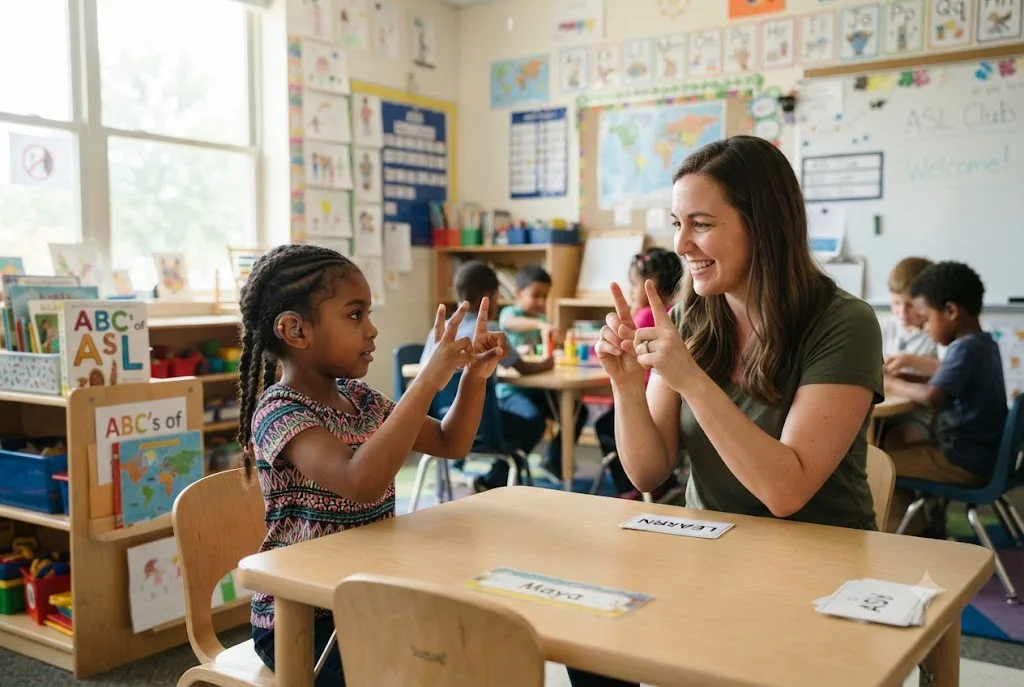
How do deaf people learn sign language? This is one of the most common questions for anyone exploring deaf education, communication accessibility, and language development in the United States. The process is both natural and structured, depending on the individual’s environment, exposure, and educational resources. Understanding how sign language is acquired provides valuable insight into how language works beyond spoken communication.
In this guide, we’ll explore the sign language learning process, how American Sign Language (ASL) is introduced, and how deaf individuals develop fluency through different pathways.
Understanding Deaf Education in the USA
Deaf education plays a central role in how deaf people learn sign language. In the U.S., children who are deaf or hard of hearing may attend specialized schools, mainstream schools with support services, or bilingual programs that incorporate ASL and English.
Educational approaches generally fall into three categories:
- Bilingual-bicultural (Bi-Bi): Focuses on ASL as the primary language and English as a second language.
- Total communication: Uses a mix of sign language, speech, and visual aids.
- Oral approach: Emphasizes speech and lip reading, sometimes with limited signing.
Each method influences how quickly and effectively a child develops ASL skills. Early exposure is critical, as language acquisition is strongest during early childhood.
Early Language Exposure and Family Influence
The answer to how do deaf people learn sign language often begins at home. Deaf children born to deaf parents are typically exposed to sign language from birth. This natural immersion mirrors how hearing children learn spoken language.
However, most deaf children are born to hearing parents. In these cases, families may need to learn ASL themselves or rely on early intervention programs. Many parents also explore communication strategies similar to baby sign language development stages to support early bonding and communication.
Early exposure significantly impacts fluency, cognitive development, and social confidence.
The Sign Language Learning Process Explained
The sign language learning process follows patterns similar to spoken language acquisition, but with visual and spatial elements. It typically involves:
1. Visual Recognition
Children first learn to recognize signs through observation. Facial expressions, hand shapes, and movement patterns become familiar.
2. Imitation
Just like spoken words, signs are copied. Repetition helps build muscle memory and understanding.
3. Vocabulary Building
Basic signs for everyday objects, actions, and emotions are introduced. Over time, vocabulary expands.
4. Grammar Development
ASL has its own grammar structure, which differs from English. Learners gradually understand sentence formation and spatial grammar.
5. Fluency Through Interaction
Regular interaction with fluent signers helps refine skills and improve communication speed and accuracy.
This progression highlights that ASL acquisition is a complete linguistic process, not just a collection of gestures.
Role of Schools and Deaf Communities
Schools for the deaf and local communities provide immersive environments where sign language thrives. These settings allow learners to practice daily, engage socially, and build cultural identity.
Community involvement is especially important because sign language is deeply tied to Deaf culture. Social interaction accelerates learning and reinforces real-world communication skills.
Additionally, exposure to different signing styles helps learners understand variation, similar to how dialects exist in spoken languages. For example, learners may later explore Black American Sign Language and its unique features as part of understanding sign language diversity.
Technology and Modern Learning Tools
Technology has transformed how deaf people learn sign language. Today, learners can access:
- Online ASL courses and tutorials
- Video-based learning platforms
- Mobile apps with interactive lessons
- Virtual classrooms and remote interpreters
These tools make learning more accessible, especially for families without immediate access to deaf education programs.
For authoritative information on language acquisition and accessibility, resources from the National Institute on Deafness and Other Communication Disorders provide valuable insights.
Challenges in Learning Sign Language
While many deaf individuals achieve fluency, the journey can vary based on several factors:
- Delayed exposure to sign language
- Lack of access to trained educators
- Limited family involvement
- Inconsistent communication environments
These challenges can impact language development, which is why early intervention and consistent exposure are strongly recommended.
Comparing ASL Acquisition to Other Learning Scenarios
Understanding how do deaf people learn sign language also opens the door to broader questions about communication and cognition. For instance, researchers have explored whether non-human learners can acquire sign systems, leading to discussions like can animals learn sign language and communication cues.
While human language acquisition is far more complex, these comparisons highlight the uniqueness of ASL as a fully developed language.
Why Early and Consistent Learning Matters
Language is essential for cognitive, emotional, and social development. When deaf individuals have early and consistent access to sign language, they are more likely to:
- Develop strong literacy skills
- Build confidence in communication
- Engage more effectively in education
- Form meaningful social connections
This is why educators and experts emphasize early ASL exposure as a foundational step in deaf education.
Conclusion
So, how do deaf people learn sign language? The process combines natural exposure, structured education, community interaction, and modern technology. Whether learned at home, in school, or through digital platforms, ASL acquisition follows a rich and dynamic path similar to spoken language development.
By understanding this process, we not only support better communication but also promote inclusivity and awareness in society. As sign language continues to gain recognition, its role in education and everyday life becomes even more important.